Lookalikes to rule out
Devil's Urn
cautionUrnula craterium is a thicker spring cup with a dark scaly exterior and tough flesh rather than a thin wavy trumpet.
Pig's Ear
cautionGomphus species are fleshier, often violet or tan, and have a veined, ridged outer surface.
Other Craterellus species
harmlessRegional black trumpets may require geography and microscopy to separate from this Eurasian name.
Identification
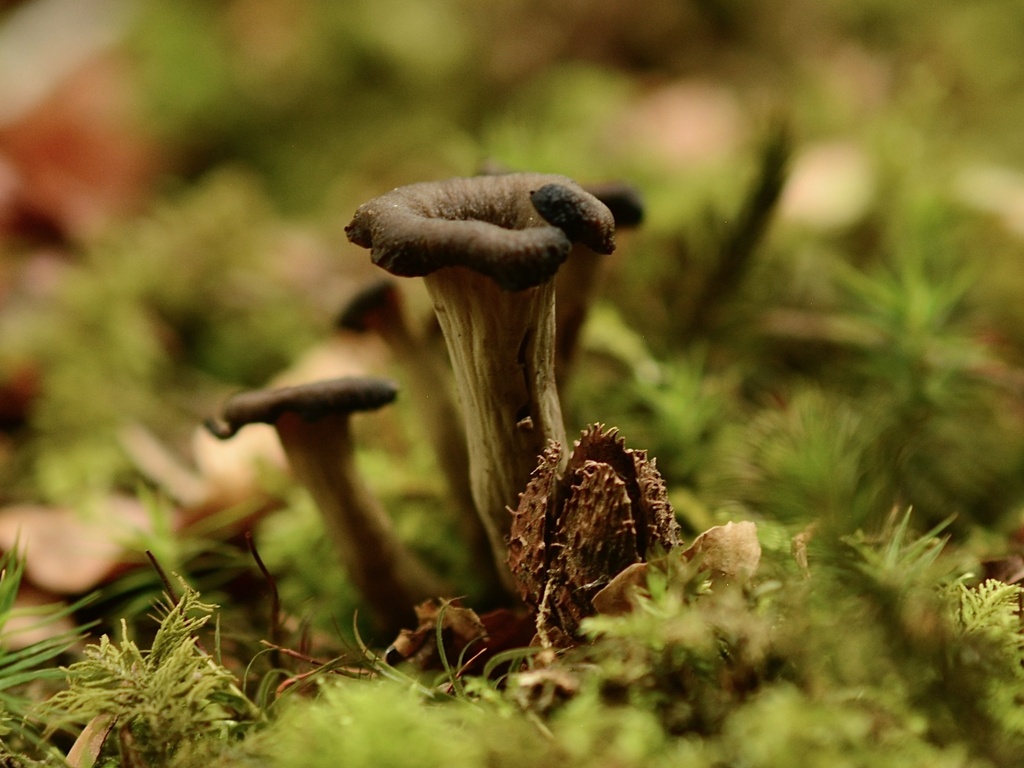
The fruiting body is one continuous hollow funnel, dark gray to nearly black inside and ash gray outside. Its rim is wavy and irregular. The outer fertile surface is smooth, powdery, or only faintly wrinkled, never lined with true gills. Flesh is thin and tears easily.
Black trumpets can be remarkably difficult to see against dark leaf litter. Search for clustered holes and wavy rims rather than a conventional cap-and-stem silhouette.
Uses and ecology
Black trumpets are aromatic cooked mushrooms and dry well. Their dark color can hide soil, insects, and forest debris, so each funnel should be opened and cleaned. Species called black trumpets occur in several regions; C. cornucopioides is centered in Eurasia, with related named and unnamed taxa elsewhere.
Like chanterelles, they are mycorrhizal partners of living trees and cannot be understood from the fruiting body alone.
Memorable fact
Their camouflage is so effective that finding one often reveals many more that were already in plain sight.