Lookalikes to rule out
Sheathed Woodtuft
deadlyKuehneromyces mutabilis is dangerously similar and requires expert attention to cap, stem scales, and spore evidence.
Honey Mushroom
deadlyHoney mushrooms are usually larger with pale spores; mixed clusters can still put a deadly Galerina in the same basket.
Mica Cap
deadlyCoprinellus micaceus grows in dense clusters and develops black gills and spores rather than rusty brown ones.
Identification
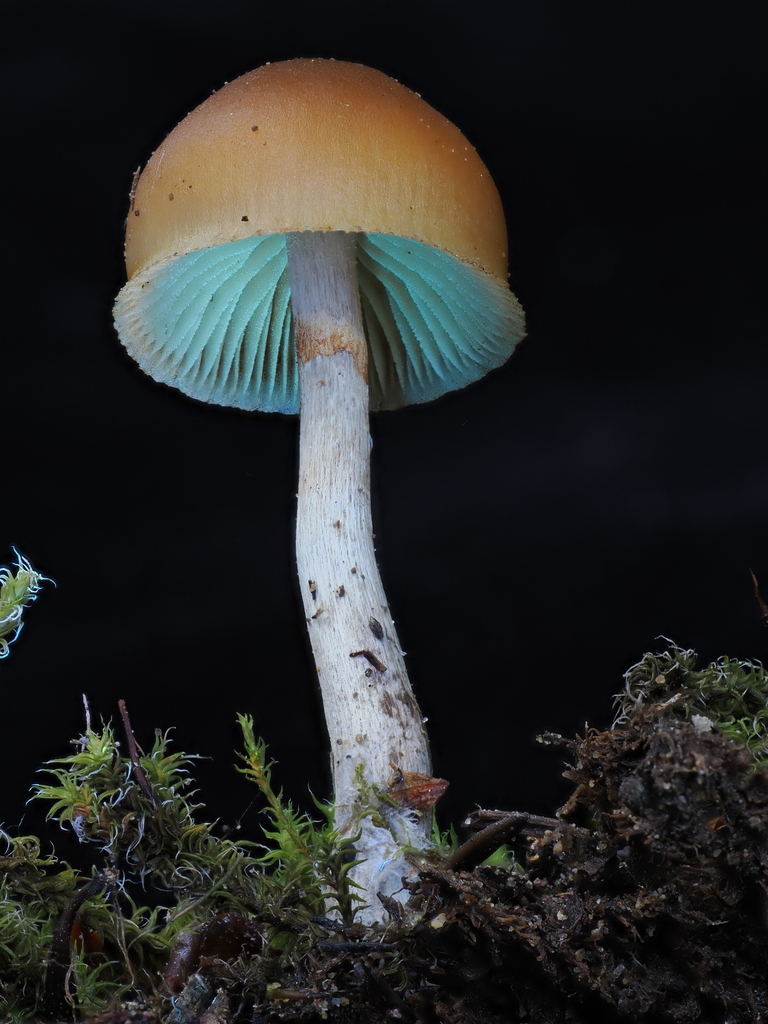
Caps are small, honey brown to tawny, and hygrophanous, fading paler as they dry. Gills attach to the stem and change from yellowish to rusty brown. A thin ring or ring zone may be visible on the upper stem, while the lower stem is often darker and fibrous. It fruits singly or in small groups from decaying wood.
These features overlap many harmless or edible wood-growing mushrooms. Microscopy and expert experience may be needed, which is why the practical beginner rule is to avoid all little brown mushrooms as food.
Why it matters
Deadly Galerina contains the same amatoxin class associated with death caps. Symptoms may be delayed for 6 to 24 hours and can progress from severe gastrointestinal illness through a false recovery to liver failure. Cooking and drying do not neutralize amatoxins.
Taxonomy has combined several former names, including G. autumnalis, into the broad G. marginata concept.
Memorable fact
A deadly Galerina can fruit on the same log and at the same time as a mushroom someone intended to collect.