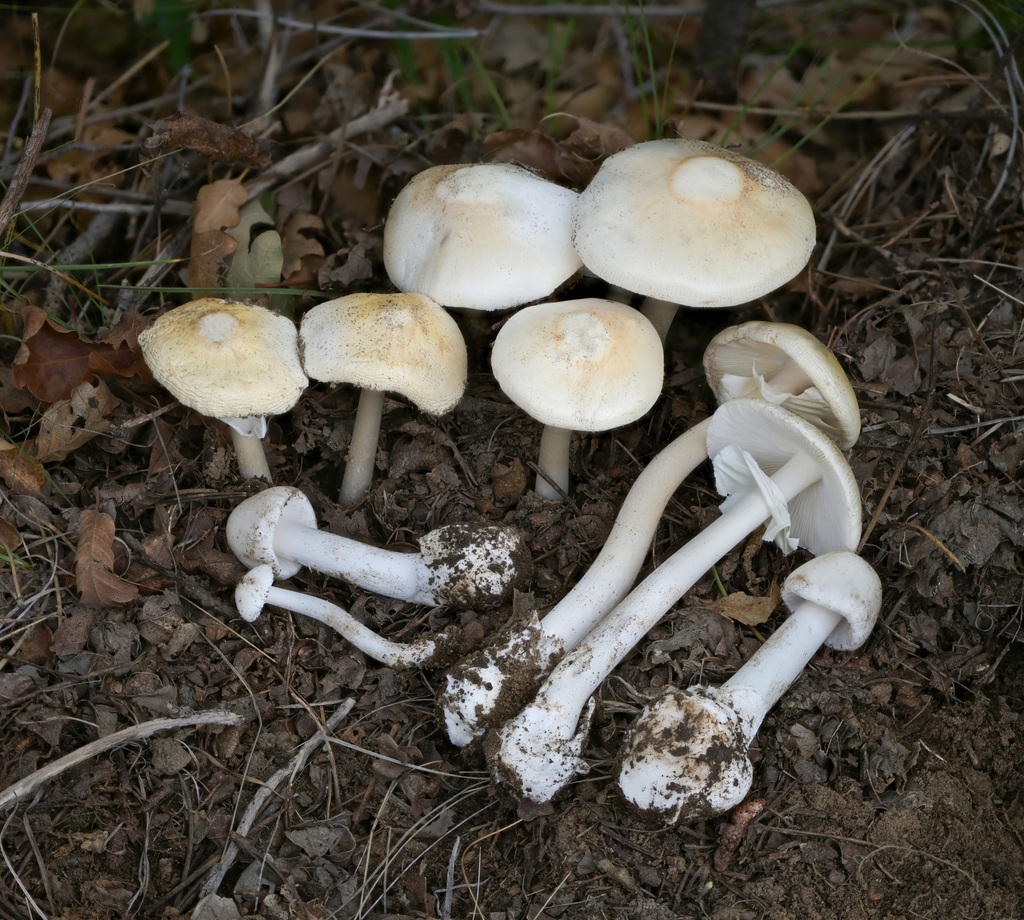
Lookalikes to rule out
Young Puffball
deadlySlice vertically; an Amanita button reveals a tiny cap, gills, and stem inside rather than uniform white flesh.
Meadow Mushroom
deadlyAgaricus gills mature from pink to chocolate brown and produce a brown spore print; there is no volva.
White Parasol
deadlyDig up the entire base. A buried sack-like volva is the critical Amanita warning.
Identification
Recognize the dangerous pattern rather than relying on one regional name: pure white cap and stem, free white gills, a white spore print, a skirt-like ring, and a sack-like volva around the base. The volva is often buried, so the entire mushroom must be carefully excavated.
Amanita bisporigera is eastern North American. Western North America has A. ocreata, while Europe has A. virosa and related species.
Why it matters
Amatoxins block RNA polymerase II and destroy liver cells. Symptoms may wait 6 to 24 hours, followed by violent gastrointestinal illness, a deceptive improvement, then liver or kidney failure. Cooking does not neutralize amatoxins. Early medical treatment matters, so do not wait for symptoms.
Memorable fact
The same molecular precision that makes alpha-amanitin deadly is being investigated for targeted cancer therapies.