Lookalikes to rule out
Black-staining Polypore
cautionMeripilus fronds rapidly bruise gray to black when rubbed or cut.
Berkeley's Polypore
cautionBondarzewia berkeleyi makes fewer, much larger pale cream to tan caps.
Umbrella Polypore
cautionPolyporus umbellatus forms many round caps on distinct slender stems rather than overlapping spoon-shaped fronds.
Identification
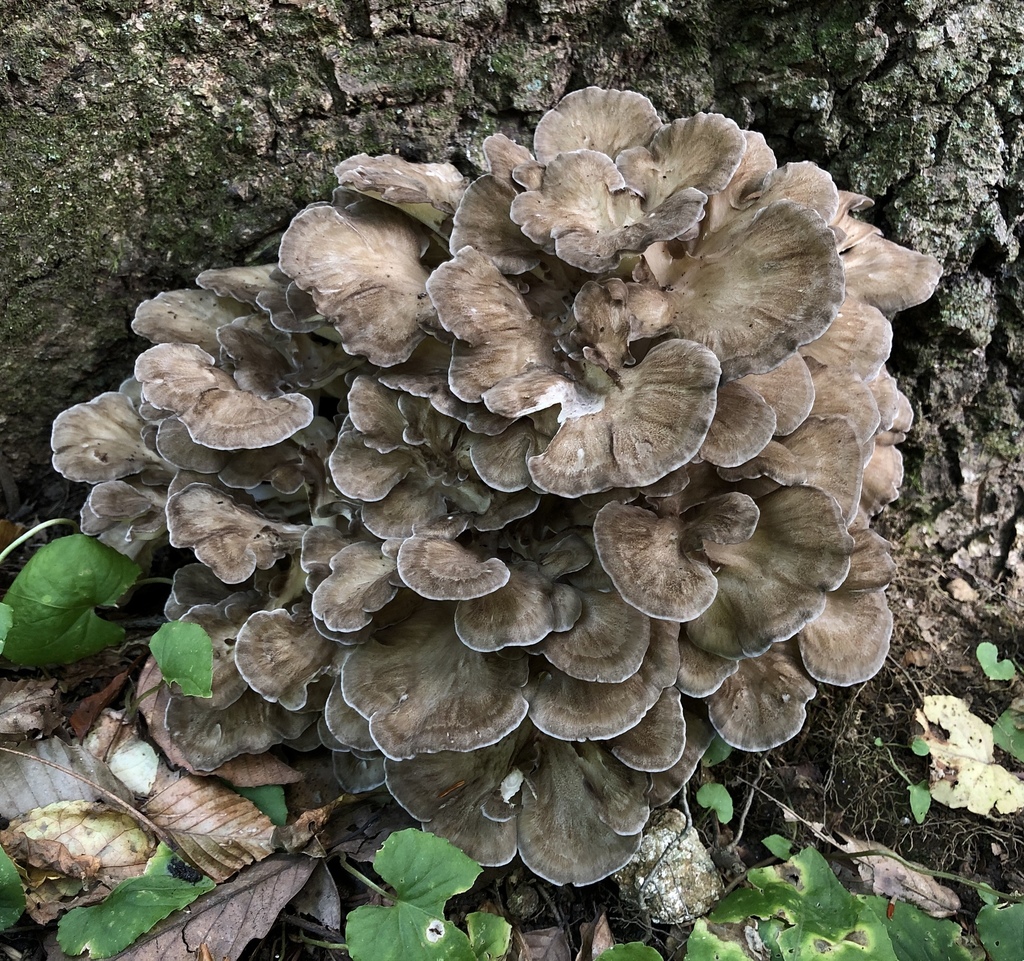
Hen of the woods forms one branching cluster that can weigh many kilograms. Dozens of gray, brown, and cream fan-shaped caps arise from a thick shared base. The undersides are white and finely porous, and the pores continue down the branches. Fresh fronds are flexible with white, firm flesh.
Check for staining. A lookalike that darkens dramatically where handled points toward black-staining polypore, not maitake. Also inspect the tree association and attachment rather than identifying a detached market-style cluster.
Uses and ecology
Young outer fronds are valued when cooked; the dense central base and old edges become tough. Maitake is also cultivated. Supplement extracts are a separate product from a food identification, and health claims should not replace clinical care.
The fungus causes a root and butt rot in hardwoods. Its fruiting bodies may return near the same tree for many autumns, sometimes before the weakened root system is obvious.
Memorable fact
The Japanese name maitake is commonly translated as dancing mushroom, often linked to the delight of finding a valuable cluster.