Lookalikes to rule out
Jack-o'-lantern
toxicJack-o'-lanterns have true blade-like gills and separate stems; chicken of the woods has a pore surface and grows as shelves.
Berkeley's Polypore
cautionBondarzewia berkeleyi forms a pale tan ground-level rosette rather than vivid orange and yellow shelves.
Black-staining Polypore
cautionMeripilus fronds are gray-brown and bruise black, especially along handled edges.
Identification
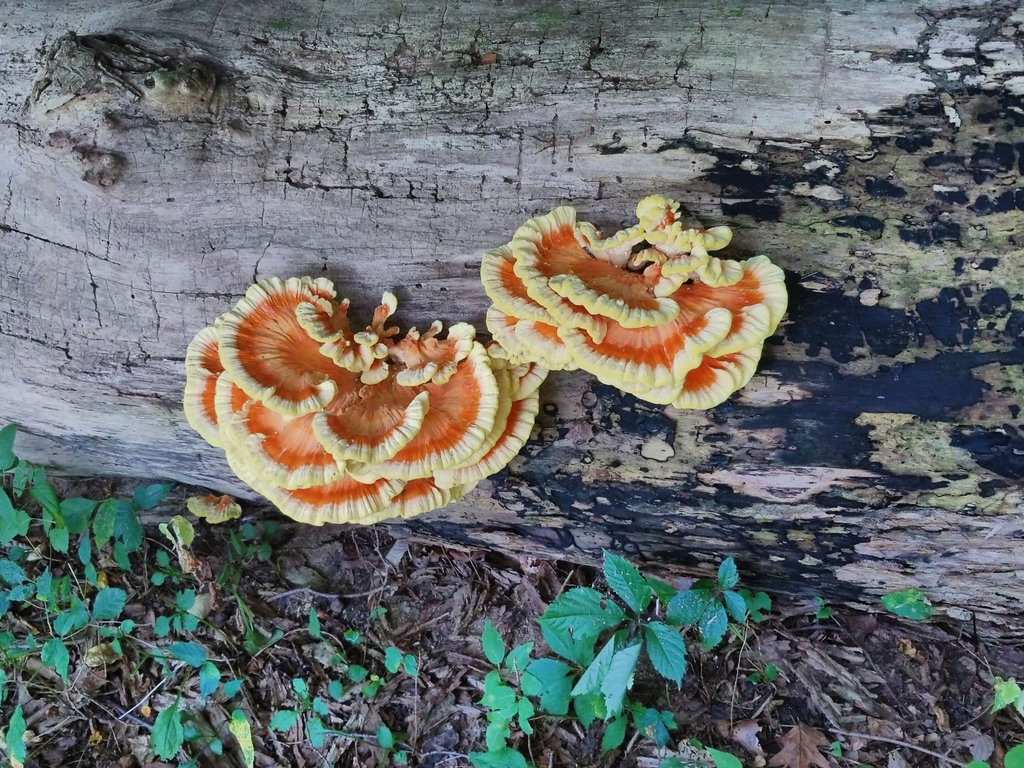
Look for overlapping, fan-shaped shelves colored orange above and yellow to cream at the margin. The underside is covered in tiny pores, not gills. Young flesh is thick, moist, and tender; old shelves become pale, crumbly, and tough. Laetiporus sulphureus usually fruits directly from hardwood in Europe and eastern North America.
The common name covers several regional species. L. cincinnatus often forms a ground-level rosette from buried oak roots and has a white pore surface, while western conifer-associated species have their own names and risk discussions. Record the host tree and attachment point.
Uses and ecology
Young, positively identified material is widely cooked as food. It must never be eaten raw, and a small first serving is prudent because nausea and other gastrointestinal reactions are reported. Host association, undercooking, age, and individual sensitivity have all been proposed as factors, but no single rule eliminates the risk.
These fungi decompose heartwood and can fruit from a tree whose internal wood is already extensively decayed.
Memorable fact
A flush can reappear from the same infected tree for years even when little decay is visible outside.