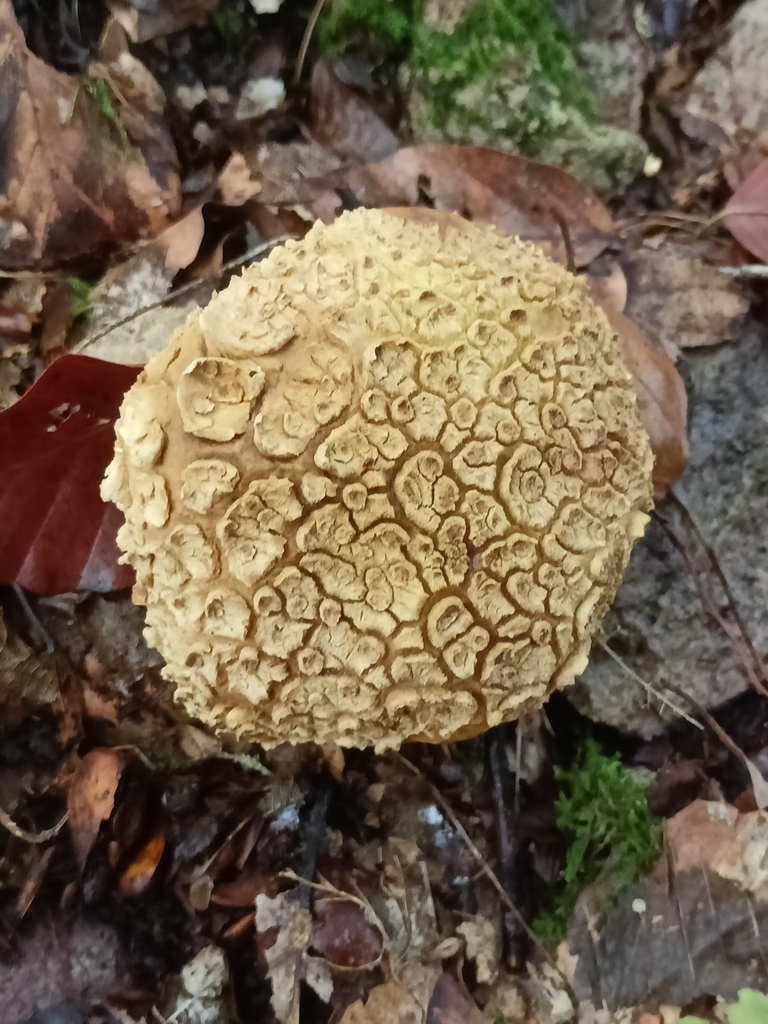
Lookalikes to rule out
Giant Puffball
toxic confusionAn edible-stage puffball has a thinner skin and a completely uniform white interior.
Gem-studded Puffball
toxic confusionGem-studded puffballs have detachable spines and homogeneous white flesh when young.
Amanita button
deadlyA vertical slice reveals a developing cap, gills, and stem inside an Amanita veil.
Identification
Common earthballs are round to irregular, usually without a distinct stem, and attached by root-like mycelial cords. The outer rind is thick, tough, and yellow-brown with coarse scales or polygonal cracks. Cut one open: the center soon becomes firm purple-black marbled with pale lines, then turns powdery at maturity.
Do not use outside color or roundness alone. A complete vertical slice is the fastest way to separate earthball tissue, a true puffball, and an enclosed Amanita button.
Why it matters
Eating earthballs can cause vomiting, abdominal pain, and other gastrointestinal symptoms. Reports also describe dizziness or faintness. They are sometimes sliced into dishes after being mistaken for young puffballs.
Earthballs form mycorrhizal partnerships with trees. The parasitic bolete Pseudoboletus parasiticus may grow directly from an earthball, producing one of the stranger mushroom-on-mushroom pairings in a forest.
Memorable fact
The common name pigskin poison puffball describes both its tough rind and the exact mistake to avoid.